

What does it cost to sell a house in the RGV? For Rio Grande Valley homeowners, the answer involves more than simply subtracting the mortgage balance from the selling price.
A seller may need to account for brokerage fees, title and closing expenses, mortgage payoff, negotiated concessions, repairs, property-tax adjustments and other transaction costs. The exact amount can vary considerably from one sale to another.
That means two RGV homeowners who sell for exactly the same price could walk away from closing with very different amounts.
What Affects the Cost to Sell a House in the RGV?
There is no universal percentage that tells every homeowner exactly what it will cost to sell a house in the RGV. Your total selling costs depend on the property and the terms of the transaction.
The agreements involved also matter. So do the terms negotiated with a buyer, the condition of the home, existing mortgages or liens and the expenses associated with closing.
Potential costs and financial considerations for an RGV seller can include:
- Brokerage compensation the seller has agreed to pay
- Negotiated contributions toward certain buyer expenses or brokerage compensation
- Title-related and escrow expenses
- Property-tax and other closing adjustments
- Repairs or improvements made before listing
- Repairs, credits or other terms negotiated during the transaction
- Survey or other transaction expenses when applicable
- Mortgage and other lien payoffs
- Other expenses agreed to in the sales contract
Not every seller will have every expense on this list. That’s why a seller-net estimate can provide a more useful picture than relying on a generic percentage.
How Do Brokerage Fees Affect the Cost of Selling an RGV Home?
Brokerage compensation can be one of the larger expenses associated with selling a home. However, there is no government-set commission rate.
The Texas Real Estate Commission states that broker compensation is not set by law and is fully negotiable.
A seller and listing broker agree on compensation for the services provided. Depending on the transaction, a seller may also agree to contribute toward brokerage compensation owed by a buyer.
RGV homeowners should therefore evaluate brokerage fees based on their actual agreements. Sellers should not treat a particular commission percentage as a rate required by Texas law.
Do Closing Costs Affect the Cost to Sell a House in the RGV?
Yes. Title and closing expenses can affect what an RGV homeowner ultimately receives from a sale. A seller may see several of these items on an estimated net sheet or closing statement.
According to the Texas Department of Insurance, Texas regulates title-insurance premium rates. Title companies charge the same regulated premium for the same policy amount.
That does not mean the seller automatically pays the owner’s title-insurance premium. The buyer and seller may negotiate who pays it.
Other closing-related charges can vary. TDI notes that certain escrow fees and closing costs can differ between title agents.
For that reason, an RGV seller should look at the expenses associated with the specific transaction rather than assume every Texas home sale has identical closing costs.
Can an RGV Seller Pay Some of the Buyer’s Costs?
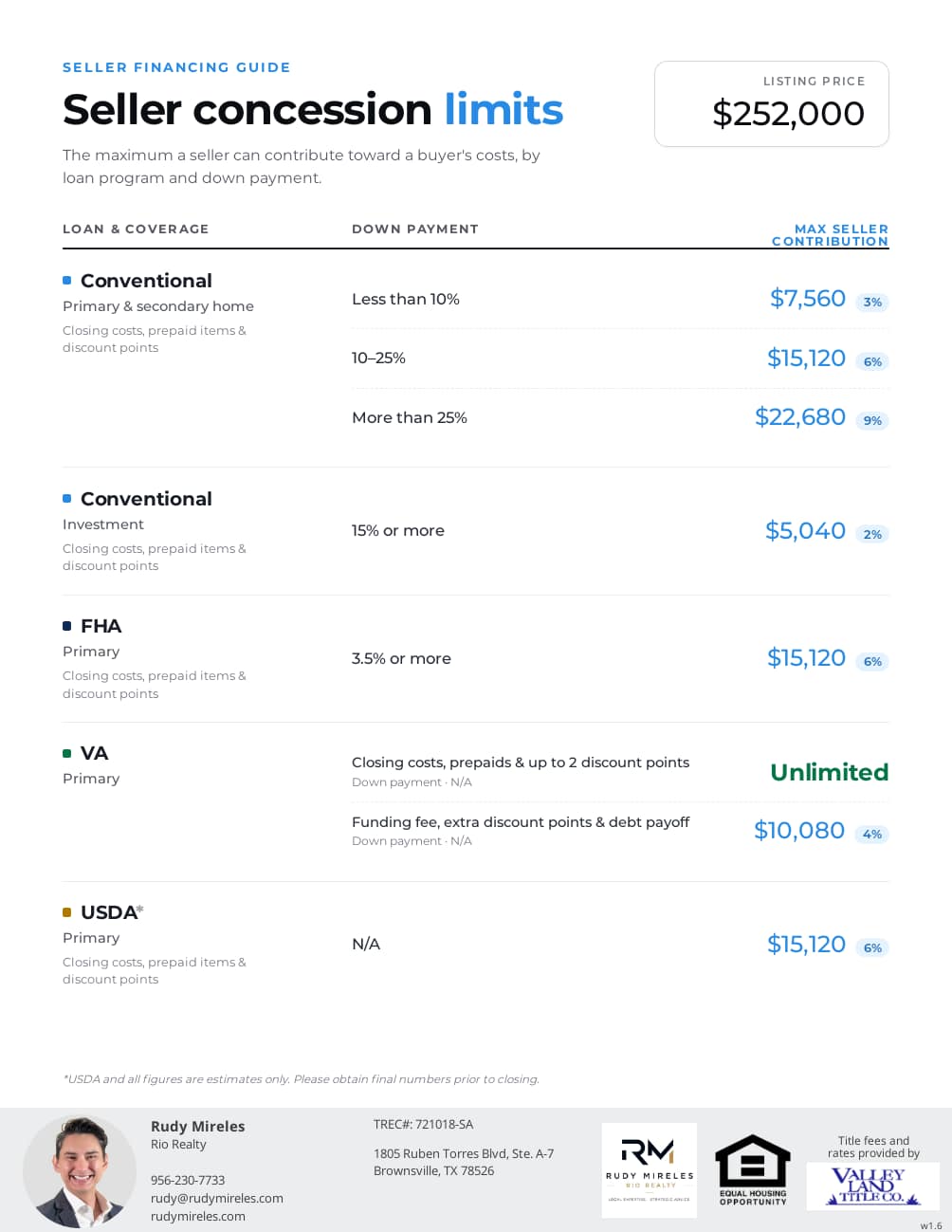
Yes. Depending on the contract, financing and negotiated terms, a seller may agree to contribute toward certain buyer expenses.
The amount permitted can depend on the buyer’s loan program, down payment and the type of cost involved. The graphic above illustrates how seller-contribution limits can differ among conventional, FHA, VA and USDA financing scenarios. It uses a hypothetical $252,000 home price for comparison.
For example, the conventional scenarios shown in the graphic vary based on down payment and occupancy. FHA and USDA have their own limits in the illustrated scenarios.
VA financing requires some additional explanation. The graphic separates certain allowable closing costs and prepaid items from other seller concessions. Sellers should not interpret the word “unlimited” in one category as meaning every possible VA seller contribution is unlimited.
Actual allowable contributions depend on the financing program, transaction and lender requirements. Buyers and sellers should confirm the applicable limits for a specific transaction.
From a seller’s perspective, the key question is how a requested contribution affects the overall offer. Two buyers could offer the same price but request different seller contributions. Those offers could produce different estimated net proceeds.
Can Repairs Increase the Cost to Sell a House in the RGV?
Yes. Repairs and preparation can add to the cost to sell a house in the RGV.
Some homeowners spend money before listing to improve the property’s presentation or address known maintenance issues. That could include cleaning, landscaping, paint, minor repairs or larger projects.
That doesn’t mean every RGV home needs a major renovation before going on the market. Instead, sellers should consider whether a particular improvement makes sense for the home’s condition, competition and expected return.
The parties may also negotiate repairs, credits or other terms after the home goes under contract. Those negotiations can change the seller’s estimated proceeds.
How Does a Mortgage Payoff Affect Your Seller Proceeds?
If you still have a mortgage, you need to account for the loan payoff when estimating what you could receive from a sale.
Your mortgage payoff isn’t technically the same as a selling expense. However, it directly affects the amount of equity that may remain for you at closing.
For example, selling a property for $252,000 does not mean the seller receives $252,000. The transaction must account for an outstanding mortgage or other liens, along with applicable expenses and closing adjustments.
The final mortgage payoff may also differ from the principal balance on a recent statement. A payoff statement can include interest and other amounts due through the payoff date.
What About Property Taxes When Selling an RGV Home?
Property taxes are another item to consider when estimating seller proceeds.
The amount attributed to the seller depends on the property, closing date and terms of the transaction. These adjustments can affect the final numbers.
That’s another reason a seller net sheet can provide a clearer estimate than simply subtracting the mortgage balance from an expected selling price.
How Do Selling Costs Affect Your Net Proceeds?
Understanding RGV home selling costs becomes easier when you separate the sale price from the amount you may ultimately receive.
- Sale price: The price the buyer and seller agree to in the contract.
- Seller expenses and adjustments: Applicable costs, credits, contributions and other amounts assigned to the seller.
- Mortgage and lien payoffs: Amounts that must be satisfied from the transaction when applicable.
- Net proceeds: The estimated amount remaining for the seller after applicable expenses, adjustments and payoffs.
This distinction becomes particularly important when comparing offers. The purchase price alone doesn’t tell you everything about the financial result of a transaction.
How I Estimate What an RGV Seller Could Walk Away With
When I help an RGV homeowner evaluate a potential sale, I don’t want to stop at an estimated selling price. I also want the seller to understand what different scenarios could mean for their estimated net proceeds.
I use seller-estimate tools available through Valley Land Title Co. to help prepare estimated scenarios for clients.
These tools allow us to consider several assumptions. They can include potential sale price, loan balance, closing date, brokerage fees, repairs, property taxes and other transaction expenses.
That lets us compare scenarios rather than look at one number in isolation. We can compare potential sale prices, examine a requested seller contribution or see how different transaction terms could affect estimated proceeds.
Valley Land Title also provides resources for real estate professionals covering parts of the title and closing process.
These calculations are estimates, not guarantees. Final figures depend on the actual contract, mortgage and lien payoffs, closing date, taxes and title charges. Brokerage agreements, negotiated expenses and other transaction details can also change the result.
How Does Your RGV Home’s Value Affect the Cost of Selling?
Before calculating the potential cost to sell a house in the RGV, you first need a reasonable idea of what the property could sell for.
Relevant comparable sales, current competition, property condition and local market conditions all matter when estimating a potential selling-price range.
I explain that process in more detail in How Much Is My House Worth in the Rio Grande Valley?
Once you have a potential selling-price range, you can begin estimating different scenarios. That helps show how expenses and negotiated terms could affect your proceeds.
Current market conditions matter too. My RGV Housing Market Report looks at sales activity and inventory across the region.
Should You Calculate RGV Home Selling Costs Before Listing?
Yes. You don’t have to wait for an offer to start estimating the financial side of a potential sale.
Before listing, you can start with a potential selling-price range. From there, you can look at different scenarios for expenses and estimated net proceeds.
That information can help if you’re deciding whether to sell. It can also help you estimate how much equity might be available for another purchase or plan for a future move.
Thinking About Selling Your RGV Home?
If you’re considering selling in the Rio Grande Valley, understanding what your home could potentially sell for is only the first part of the equation.
I can help you review relevant comparable sales, current competition and local market conditions. From there, we can look at estimated seller-net scenarios before you make a decision.
You don’t have to be ready to list. We can start by looking at what your home could potentially sell for, what expenses may be involved and what different scenarios could mean for you.
Request a Home Value and Seller Net Analysis →
Seller expenses, brokerage compensation, concessions, title and escrow charges, taxes, repairs, payoffs and other expenses vary by property and transaction. Brokerage compensation is negotiable and is not set by law. Seller net sheets and estimated sale prices are estimates only and do not guarantee a particular sale price, expense or amount of proceeds. Financing programs and seller-contribution limits are subject to applicable guidelines and transaction-specific requirements. This article is for general informational purposes and is not legal, tax, appraisal, lending or financial advice.
Sources: Texas Real Estate Commission; Texas Department of Insurance; Texas Department of Insurance Title Insurance Resources; Valley Land Title Co.
