

RGV data centers are moving from an abstract idea to a major economic-development question for the Rio Grande Valley. They bring the possibility of billions of dollars in investment alongside questions about housing, land, jobs, electricity, water and infrastructure.
Those questions are particularly relevant in Cameron County, where developers are proposing major data center projects. Communities across Texas and the country are already wrestling with what this rapidly expanding industry could mean for the places where people live and work.

The Queen Isabella Memorial Causeway connects Port Isabel and South Padre Island in Cameron County. Infrastructure is one of the issues to watch as developers propose major data center projects in the Rio Grande Valley. Photo: Rudy Mireles
One of those projects is the proposed RGV Data Center from Eneus Energy. The company says the project remains in its initial planning and evaluation phase on a 1,785-acre site in Cameron County. Its design could support up to 2 gigawatts of total power capacity and 16 typically sized data halls.
Eneus projects more than $14 billion in capital investment and more than $9 billion in total economic impact. It also projects roughly 1,000 jobs, including 360 data center positions. The company bases those long-term projections through 2045 on an economic and fiscal impact study. They are estimates rather than guaranteed outcomes.
Those are enormous numbers. But they also lead to an enormous question: What could data centers actually change for the Valley?
New research from the National Association of REALTORS® offers one way to examine that question. The research looks at what has happened in communities across the country where data centers already exist.
The findings do not fit neatly into either side of the debate.
Some economic and real estate indicators are stronger in counties with data centers. At the same time, REALTORS® working in these markets report concerns involving residential demand, electricity, water and the surrounding landscape.
Perhaps most importantly, the research shows associations. It does not prove that data centers caused the differences between counties.
There Is No Single Effect From RGV Data Centers
The National Association of REALTORS® analyzed housing, employment, demographic and electricity data from counties across the United States. NAR combined that research with a survey of REALTORS® working in markets where data centers operate or are under development.
Its conclusion is particularly relevant as RGV data centers enter the regional conversation: there is no single national “data center effect.”
Counties with data centers generally had higher home values, higher household incomes and stronger long-term employment growth than counties without them. But those relationships do not establish that data centers produced those differences.
Many major data center markets were already large metropolitan areas, technology centers or fast-growing communities before significant data center development occurred.
That distinction — correlation versus causation — matters throughout this analysis.
What RGV Data Centers Could Mean for Housing and Home Values
Housing provides one of the clearest examples of why the data deserves a closer look.
From 2014 to 2024, the median increase in home values was 64.2% in counties with no mapped data centers.
Counties with one or two data centers recorded median growth of 72.3%. Counties with three to nine recorded 98.3% growth, while counties with 10 or more recorded 95.0%.
The pattern is notable, but it is not linear. Counties in the medium-concentration group actually recorded slightly greater median appreciation than counties with 10 or more data centers.
That makes it difficult to support a simple conclusion that adding more data centers automatically produces greater home appreciation.
The comparison also provides important context for the Rio Grande Valley. The region has already experienced substantial housing appreciation without historically serving as a major national data center hub. I previously examined that trend in my analysis of 10 years of Rio Grande Valley home appreciation.
REALTORS® Report a Mixed Residential Impact
NAR’s survey provides another perspective on what residents could experience around data center development.
Among REALTORS® surveyed, 25% reported a positive effect on residential property values near data centers. Another 22% reported a negative effect.
The demand picture leaned somewhat differently. Nineteen percent reported increased residential demand near data centers, compared with 26% who reported decreased demand.
Those responses reinforce why broad national averages cannot tell a homeowner exactly what will happen to an individual property near a future facility.
Distance from a project could matter. So could surrounding land uses, visibility, noise, infrastructure, employment effects and the characteristics of the individual market.
For that reason, the effects of RGV data centers may require a project-by-project and neighborhood-by-neighborhood analysis rather than a single regional conclusion.
RGV Data Centers Could Affect Commercial Real Estate Differently
The survey responses changed considerably when NAR asked REALTORS® about commercial real estate.
Half reported a positive effect on commercial property values near data centers, compared with 14% who reported a negative effect. Meanwhile, 42% reported increased commercial demand and 7% reported decreased demand.
The contrast between residential and commercial responses is one of the more significant findings in the research.
Large data center developments need land, electrical infrastructure, fiber connectivity and other supporting infrastructure. Those requirements can affect nearby industrial and commercial property differently than nearby housing.
Land and Industrial Property Could Be Important to the Valley
REALTORS® most frequently identified industrial property as experiencing increased demand near data centers, at 58%. Land followed at 38%.
The regional result is especially relevant. Forty percent of respondents in the South reported increased demand for land near data centers.
That does not mean land surrounding proposed RGV data centers will necessarily follow the same pattern. It does, however, identify one part of the local economy worth watching as projects progress.
Even within the Valley, real estate markets do not necessarily move together. My recent RGV housing market analysis comparing McAllen and Brownsville found substantially different inventory conditions within the same region.
Energy and Water Are Key Questions for RGV Data Centers
The potential economic effects are only one part of the discussion.
NAR also asked REALTORS® about concerns they hear in markets with data centers. Energy costs ranked first at 61%, followed by water use at 56%. Respondents also cited environmental contamination at 43% and impacts to the immediate landscape at 32%.
These are reported concerns. They do not show that every data center produces those effects.
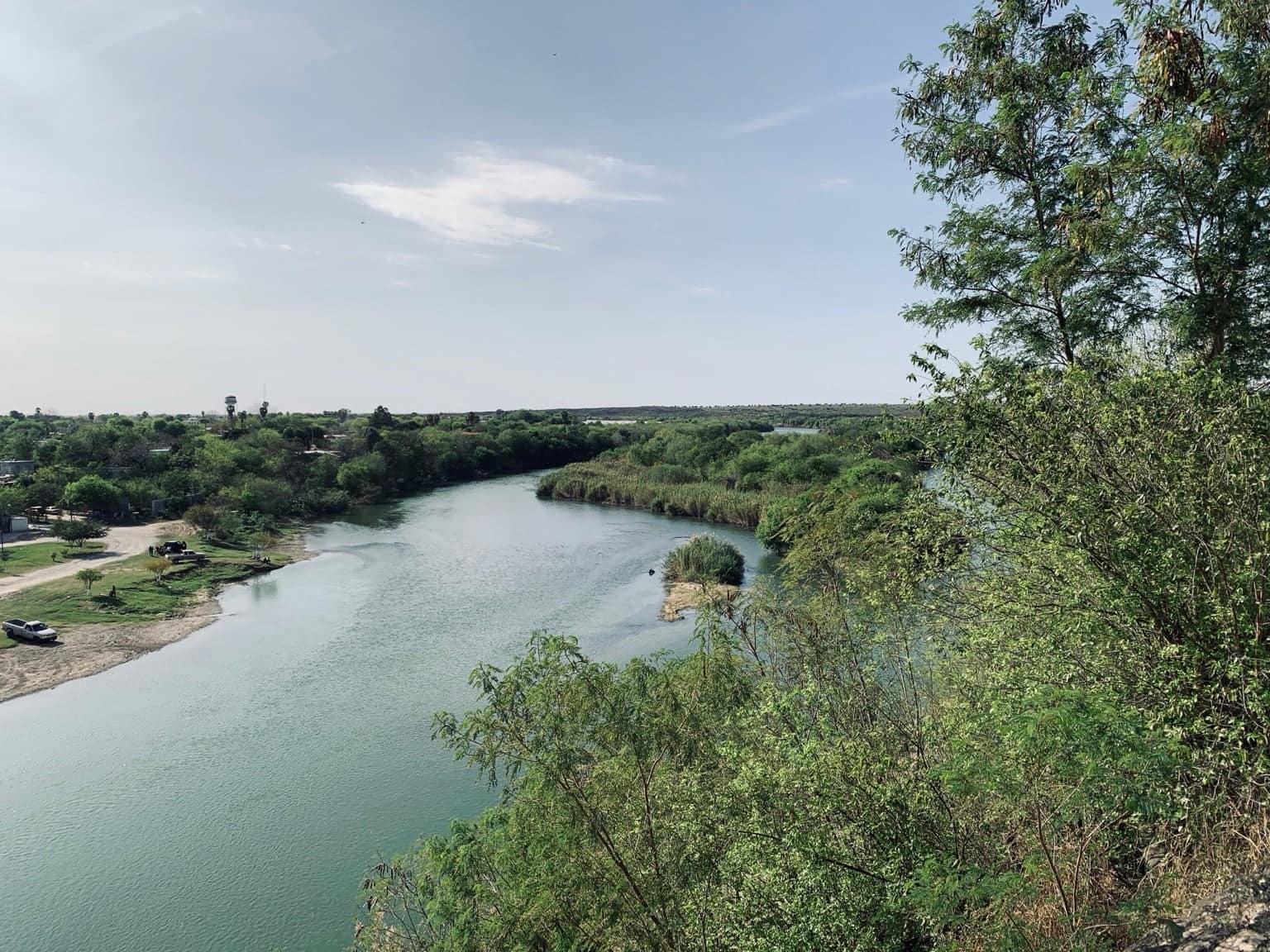
The Rio Grande as seen from Roma, Texas. Water use is among the issues communities are discussing as data center development expands across Texas. Photo: Rudy Mireles
Project design can also matter. Eneus Energy says its proposed Cameron County project would support closed-cycle cooling systems. The company says those systems could use locally sourced reclaimed wastewater rather than the local potable water supply.
The company also says it is developing a flexible power strategy intended to manage overall grid impacts.
Those statements describe the developer’s proposed design and objectives. The project’s development and eventual operation, if built, would provide more information about how those plans work in practice.
What Electricity Data Can Tell Us About RGV Data Centers
Because energy costs topped the REALTOR® survey’s list of concerns, the electricity findings deserve particular attention.
Residential electricity rates increased 15.7% from 2020 to 2024 in counties without data centers. Rates rose 22.9% in counties with one or two centers. The increases were 16.8% in counties with three to nine and 21.4% in counties with 10 or more.
Again, the pattern is not linear. The largest increase occurred in the low-concentration group rather than in counties with the greatest number of data centers.
The comparison also has an important limitation. NAR’s analysis assigns state-level residential electricity rates to counties. Those figures do not show individual utility rates or identify who ultimately paid infrastructure costs associated with a particular data center.
National comparisons therefore provide context for the Rio Grande Valley, but they cannot answer the local question by themselves. Individual projects will require a closer look at power needs, interconnection arrangements, infrastructure and cost allocation.
What Texas Data Center Markets Can Tell the Valley
Texas provides a useful comparison because it already contains some of the country’s largest data center markets.
NAR’s underlying county dataset identifies 127 data center locations across 16 Texas counties.
I separated those Texas counties from the national dataset. I then compared each county’s number of data center locations with its change in home values from 2014 to 2024.
The Texas results reinforce the broader finding. There is no obvious one-size-fits-all relationship between data center concentration and housing performance.
Ellis County had 15 mapped data center locations and 149% home-value growth over the decade. Dallas County had 25 locations and 135% growth. Bexar County had 33 — the most among the Texas counties in the dataset — and recorded 108% growth.
Meanwhile, Texas counties with only one or two data centers experienced a wide range of housing outcomes.
This comparison does not demonstrate that data centers increased or decreased home values in any of those counties. It shows how substantially outcomes can vary even within one state.
What RGV Data Centers Could Mean for Jobs and Economic Development
Jobs and investment will likely rank among the most closely watched numbers if major data center development moves forward in the Valley.
NAR found stronger long-term employment growth in counties with greater concentrations of data centers. From 2014 to 2024, median employment growth reached about 1.9% in counties without data centers. Counties with 10 or more recorded roughly 15.6%.
But that finding carries the same causation problem as the housing data. Large metropolitan areas and technology-oriented markets may have grown for reasons that also made them attractive to data center developers.
It is also important to distinguish between different kinds of economic activity.
Construction jobs, permanent jobs inside a facility and indirect employment supported by surrounding businesses are different measurements. A project’s overall estimated economic impact is another measurement entirely.
That distinction is particularly important when considering projections for proposed RGV data centers.
For example, Eneus projects roughly 1,000 jobs associated with its Cameron County development, including 360 data center positions. Those numbers represent part of the company’s long-term economic projections rather than existing jobs.
Why the Rio Grande Valley Could Be Different
National research can tell us what has happened elsewhere. It cannot tell us exactly what will happen in Cameron County, Hidalgo County or the broader Rio Grande Valley.
The Valley has its own housing supply, household incomes, available land and population trends. It also has its own electrical infrastructure, water resources and economic-development environment.
The region has also seen large-scale investments reshape parts of its economy in ways that were difficult to predict at the beginning.
Brownsville provides a separate example. SpaceX’s growth has created its own questions about investment, employment, land and housing. I previously examined those changes in my analysis of SpaceX and the Brownsville real estate market.
The Upper Valley has its own economic and housing dynamics as well. My guide to living and moving to McAllen looks more broadly at some of the factors shaping that part of the region.
That local variation matters. We cannot simply assume RGV data centers will produce the same results seen in Dallas, San Antonio, Northern Virginia or another established data center market.
What Should the Valley Watch as RGV Data Centers Move Forward?
The available research does not provide a simple answer to whether data centers are “good” or “bad” for a community.
What it does show is that communities with significant data center development have not followed a single economic or housing pattern.
For the Rio Grande Valley, the more useful questions will therefore be specific ones.
Where will developers build the facilities? How much electricity will they require, and where will that power come from? Where will projects get water, and how will they use it?
The infrastructure questions matter too. What new infrastructure will the projects require? Who will pay for it? What tax arrangements or incentives will apply?
The Valley can also track the economic results. How many temporary construction jobs and permanent positions will projects actually create? What happens to nearby land, housing and commercial development after the facilities begin operating?
For readers who want to explore the national data center landscape themselves, the IM3 Open Source Data Center Atlas provides information on existing and projected facilities. It also includes electricity infrastructure, municipal water supply and high-speed fiber availability.
Those are measurable questions. Over time, they will tell us far more about the local impact than the words “data center” alone.
RGV data centers may eventually represent one of the Valley’s largest new sources of private investment. They may also create new demands on infrastructure and raise questions that individual projects cannot answer until they move further through development.
Both deserve scrutiny.
As these projects progress, I’ll continue following the housing, land, employment, electricity, water and infrastructure data. That will give us a clearer picture of what is actually changing in the Rio Grande Valley.
This analysis provides context using currently available research, public information and developer projections. Developers may revise proposed projects, investment figures, employment estimates and infrastructure plans as development progresses. County-level relationships do not prove that data centers caused changes in housing values, employment or electricity rates.
